There is an important question we need to ask about modern recruitment:
Can HR really judge the full professional capability of a candidate simply by reading a CV?
In many cases, the answer is no.
HR professionals play an extremely important role in recruitment. They can evaluate communication, professionalism, cultural fit, behavioural characteristics, career consistency, salary expectations, availability, and many other important factors.
But when it comes to operational, technical, or functional expertise, the person making the final judgement should normally be someone who actually understands the work.
A Warehouse Manager should be assessed by someone who understands warehouse operations.
A Logistics Manager should be assessed by someone who understands logistics.
An IT professional should be assessed by someone who understands IT.
A Finance professional should be assessed by someone who understands finance.
That is where the recruitment process often becomes problematic.
A CV Is Not the Candidate
Candidates are frequently judged by keywords.
If one candidate writes:
“Inventory optimization and stock control”
and another writes:
“Inventory accuracy, cycle counting and warehouse stock management”
both candidates may have exactly the same practical experience.
Yet an ATS or recruiter may consider one CV a stronger match simply because it contains the “right” keywords.
This raises an important question:
Are we hiring the person—or hiring the words written on the CV?
Professional experience cannot always be measured by identical terminology.
Experienced professionals use different words to describe the same work.
One logistics professional may say:
- Route optimization
- Transport planning
- Delivery scheduling
- Distribution planning
- Fleet coordination
Another may use completely different terminology while performing essentially the same function.
The absence of a particular keyword does not automatically mean the absence of professional capability.
AI Has Changed CV Writing — Recruitment Must Change Too
Today, candidates have access to tools such as ChatGPT and other AI platforms.
They can improve grammar.
They can structure their CV.
They can make their achievements clearer.
They can tailor their application to a particular job description.
They can identify keywords that help their experience become more visible.
And there is nothing inherently wrong with that.
Companies themselves use technology to screen thousands of applications through ATS systems.
If organizations can use technology to improve and automate recruitment, candidates should not automatically be criticized for using technology to communicate their experience more effectively.
The important question should not be:
“Did the candidate use AI?”
The important question should be:
“Can the candidate actually do the job?”
HR Should Identify — Operations Should Validate
A better recruitment model would divide responsibilities.
HR can evaluate:
- Communication skills
- Professional presentation
- Personality and behavioural characteristics
- Cultural alignment
- Career history
- Availability
- Salary expectations
- Basic qualifications
- Professional attitude
- Language and communication ability
- General suitability for the organization
These are important areas where HR adds significant value.
The Functional/Operational Manager should evaluate:
- Technical knowledge
- Operational experience
- Decision-making
- Problem-solving
- Industry knowledge
- KPI understanding
- Systems and software knowledge
- Process knowledge
- Leadership capability
- Real-world scenarios
- Ability to handle operational pressure
This is where the actual professional judgement should happen.
The Person Who Does the Work Should Help Judge the Work
Imagine hiring a Warehouse Manager.
A recruiter may understand the job description.
But can the recruiter independently determine whether a candidate truly understands:
- Inventory accuracy?
- Cycle counting?
- WMS processes?
- Picking accuracy?
- Put-away strategies?
- Warehouse layout?
- FIFO/FEFO?
- Labour productivity?
- Dock management?
- Stock discrepancies?
- Order fulfilment?
- Warehouse KPIs?
- Cost reduction?
These are operational questions.
The strongest evaluation comes from someone who has hands-on knowledge of the operation.
The same principle applies across almost every profession.
HR Should Not Become the Technical Judge
This is not an argument against HR.
Quite the opposite.
HR has a critical role in building a fair and professional recruitment process.
But HR should not be expected to become an expert in every profession they recruit for.
One HR professional may recruit today for logistics, tomorrow for IT, next week for engineering, and later for finance.
It is unrealistic to expect one person to have deep operational expertise across every discipline.
That is why the recruitment process should be collaborative.
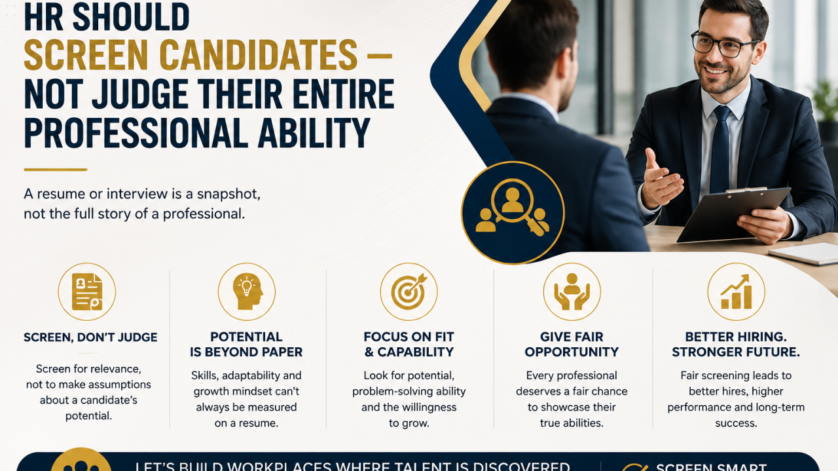
HR screens. The functional manager validates. The organization makes the final decision.
The Danger of Rejecting People Too Early
When candidates are rejected primarily because their CV does not contain a particular keyword or because their wording differs from the job description, organizations may be eliminating potentially excellent professionals before they ever get the opportunity to demonstrate their ability.
A candidate who writes differently is not necessarily less capable.
A candidate who has a non-traditional career path is not necessarily less capable.
A candidate who uses AI to improve their CV is not necessarily less capable.
And a candidate who does not perfectly mirror the wording of a job advertisement may still be exactly the person who can solve the organization’s problems.
The CV should open the door to assessment—not become the assessment itself.
Give Candidates the Opportunity to Prove Their Ability
Instead of trying to determine everything from a two-page CV, companies should consider using practical assessments and structured interviews.
For example:
“Here is a warehouse problem. How would you solve it?”
“Inventory accuracy has dropped from 98% to 91%. What would you investigate?”
“On-time delivery is declining. What actions would you take?”
“Your team is understaffed during peak season. How would you manage the operation?”
Now we are measuring something meaningful.
We are measuring thinking, experience, judgement and practical knowledge.
That is much closer to determining whether someone can actually perform the job.
Recruitment Should Be About Capability, Not Vocabulary
The future of recruitment should not be about finding candidates who are best at copying the language of a job advertisement.
It should be about finding people who can deliver results.
ATS systems can help organize applications.
AI can help improve communication.
HR can help manage the recruitment process.
But ultimately, professional capability needs professional evaluation.
The real question should always be:
“Can this person do the job?”
Not:
“Did this person use exactly the words we expected to see?”
Technology should help us discover talent—not eliminate talent.
And recruitment should give qualified candidates the opportunity to prove what they can actually do.
A better model for hiring:
ATS → HR Screening → Functional/Operational Assessment → Hiring Manager → Final Decision
That approach can create a recruitment process that is more practical, more human, and potentially much fairer to both candidates and employers.
Don’t judge the entire professional capability of a candidate from their CV.
Let the person who understands the work help determine whether the candidate can actually do it.