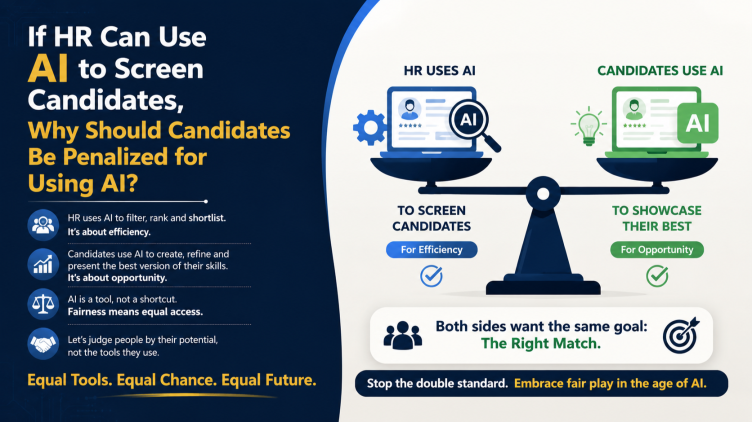
There is an interesting double standard emerging in modern recruitment.
Companies increasingly use Applicant Tracking Systems (ATS), automated screening tools, AI-powered recruitment platforms, keyword matching, assessments, and data-driven algorithms to process hundreds or thousands of applications.
At the same time, some recruiters question candidates who use ChatGPT or other AI tools to improve their CVs, cover letters, LinkedIn profiles, or job applications.
This raises a simple question:
If employers can use technology to make recruitment more efficient, why shouldn’t candidates be allowed to use technology to present themselves more effectively?
AI Should Not Be a Reason to Reject a Candidate
Using ChatGPT to draft or improve a CV does not automatically mean that a candidate is dishonest.
There is a significant difference between:
Using AI to communicate your real experience better
and
Using AI to invent experience, qualifications, achievements, or skills.
If a candidate provides accurate information about their education, employment history, responsibilities, achievements, and skills, using AI to improve the wording should not make their application less legitimate.
After all, candidates have always used tools to improve their applications.
People ask friends to proofread their CVs.
They use grammar-checking software.
They consult career coaches.
They use CV templates.
They hire professional writers.
They search online for examples.
AI is simply the newest and most powerful version of these tools.
The Recruitment Process Is Already Technology-Driven
Modern recruitment is no longer purely human-to-human.
A candidate may submit a CV through an ATS.
The system may parse the document.
Keywords may be matched against the job description.
Applications may be filtered according to predefined criteria.
Recruiters may use automated scheduling.
Online assessments may evaluate candidates.
AI may help recruiters identify potential candidates.
So candidates are entering a recruitment environment where technology already plays a major role.
It seems inconsistent to say:
“Companies can use AI to improve recruitment, but candidates should not use AI to improve their applications.”
Technology should not create a one-sided advantage.
An ATS Doesn’t Understand Every Candidate
There is another important issue.
An ATS generally works with structured information, keywords, and predefined criteria. A highly qualified candidate can sometimes be overlooked because their CV does not communicate their experience in the terminology expected by the system.
For example, a candidate may have extensive experience in:
Warehouse Management
but the vacancy may emphasize:
Supply Chain Operations, Inventory Control, WMS, Distribution, Logistics Planning, and Fulfillment.
The candidate may possess all of these capabilities but describe them differently.
Using AI to help tailor the CV to the specific vacancy can make the candidate’s genuine experience easier to understand.
That isn’t necessarily manipulation.
It can simply be better communication.
The Real Problem Is False Information — Not AI
Recruiters absolutely have a legitimate reason to be concerned about AI-generated applications when candidates use AI to fabricate information.
A candidate should never claim:
- A degree they don’t have
- A certification they never obtained
- Employment they never held
- Skills they cannot demonstrate
- Achievements they did not accomplish
- Responsibilities they never performed
That is misleading whether the information was written by a human or generated by AI.
The problem is therefore not necessarily AI-assisted writing.
The problem is misrepresentation.
The same standard should apply regardless of how the document was written.
Recruiters Should Focus on Capability
Ultimately, a CV is not the candidate.
It is a communication tool designed to help the employer understand whether the candidate may be suitable for the position.
The real test should happen during the recruitment process:
Can the candidate explain their experience?
Can they demonstrate their knowledge?
Can they perform the job?
Can they provide evidence of their achievements?
Can they answer interview questions without relying on AI?
If a candidate uses ChatGPT to improve the grammar and structure of their CV but can confidently demonstrate everything written in it during an interview, should the use of AI itself be considered a disqualifying factor?
I don’t think so.
Perhaps HR Should Establish Clear Rules
Instead of simply saying:
“Don’t use AI.”
companies could establish a more reasonable standard:
“You may use AI to assist with your application, but all information must be truthful, accurate, and genuinely representative of your experience.”
That creates a much clearer boundary.
AI can help candidates:
- Correct grammar
- Improve sentence structure
- Organize information
- Tailor a CV to a vacancy
- Identify unclear wording
- Improve readability
- Prepare for interviews
- Understand unfamiliar job descriptions
But the candidate remains responsible for the truthfulness of the final application.
There Should Be Fairness on Both Sides
Recruitment should not become a competition between:
AI-powered employers
and
AI-restricted candidates.
If technology is acceptable for one side of the recruitment process, we should have a thoughtful conversation about why it should automatically be unacceptable for the other.
The objective of recruitment should be to identify the right person for the job — not the person who wrote the most traditional CV.
A candidate should be evaluated on their experience, skills, knowledge, integrity, potential, and ability to perform, rather than simply on whether they received assistance from a writing tool.
The Future of Recruitment Is Already Here
AI is not going away.
Recruiters will continue to use ATS platforms, automation, analytics, AI sourcing, automated assessments, and other technologies.
Candidates will also continue to use AI to research companies, understand job descriptions, improve their CVs, prepare for interviews, and communicate their experience.
Instead of treating this as an arms race, perhaps recruitment should establish a simple principle:
Use AI to assist — but never to deceive.
If HR can use technology to make recruitment more efficient, candidates should also be allowed to use technology to communicate their genuine qualifications more effectively.
The question should not be:
“Did you use ChatGPT?”
The better questions are:
“Is the information accurate?”
“Can you demonstrate what you claim?”
“Do your skills match the role?”
“Can you do the job?”
And ultimately:
“Are you the right person for the position?”
That is what fair recruitment should be about.
AI should improve communication — not replace honesty.