There was a time when HR checked your background by calling your previous employers.
Today, that is becoming increasingly difficult.
Imagine an HR department receiving thousands—or even millions—of applications.
Is an HR executive really going to call every company mentioned on every CV?
“Hello, did Mr. Ahmed work for you?”
“Yes.”
“What was his position?”
“Sales Executive.”
“Was he good?”
“Let me check…”
Next company.
Next candidate.
Next 500,000 candidates.
By the time the background check is complete, the HR executive may have retired.
So HR discovered something much faster:
Google.
Search the candidate’s name.
Search the phone number.
Search the email address.
Check LinkedIn.
Check old CVs.
Check social media.
Check professional registrations.
Check different spellings of the candidate’s name.
Compare the passport.
Compare the Civil ID.
Compare previous job titles.
And suddenly, the candidate is no longer simply applying for a job.
The candidate is undergoing a digital archaeological excavation.
Background verification is perfectly reasonable.
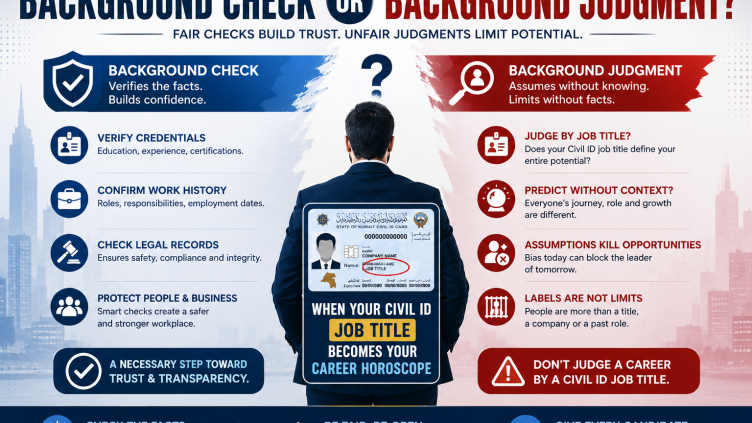
The problem starts when background verification becomes background judgment.
YOUR NAME BECOMES YOUR IDENTITY TRAIL
A clever HR person can search the same candidate in several ways.
Passport name.
Civil ID name.
Email address.
Phone number.
LinkedIn.
Old CV.
Old job advertisement.
Professional profile.
Different spellings.
And suddenly one person can appear to have several different careers.
CV:
Senior Accountant
Old CV:
Accounts Executive
Civil ID:
Clerk
LinkedIn:
Finance Professional
HR:
“Something doesn’t match.”
Candidate:
“My career progressed.”
HR:
“But your documents don’t match.”
Candidate:
“My documents changed.”
HR:
“Exactly. Suspicious.”
This is where common sense needs to enter the room.
THE CIVIL ID CAREER CURSE
One of the strangest assumptions in some recruitment environments is the belief that the occupation printed on a Civil ID or residency document must perfectly match the position mentioned on the CV.
A person may have started their career as a junior clerk.
Later they become an accountant.
Then a senior accountant.
Then perhaps a finance supervisor.
But someone looks at an old occupational classification and says:
“Your Civil ID says Clerk.”
As if the person has been permanently sentenced to clerical duties.
Another person may have entered a country as a delivery driver, developed extensive fleet knowledge, obtained additional qualifications and eventually become a transport coordinator.
Yet someone says:
“But your original occupation was driver.”
And suddenly the entire career progression becomes suspicious.
This is the strange idea that:
If you started as X, you must remain X.
Apparently, promotion requires permission from your past.
YOUR OCCUPATION IS NOT YOUR DESTINY
A government occupation is an administrative classification.
It is not a professional DNA test.
People change jobs.
People change industries.
People obtain qualifications.
People gain experience.
People get promoted.
People accept temporary positions.
People change sponsorship.
People sometimes accept a lower occupational designation for practical or administrative reasons.
The document may say one thing.
The actual career may tell another story.
And the actual question should be:
Can the candidate prove what they did?
Not:
Does every document from every stage of their life contain exactly the same job title?
RESIDENCY STATUS IS NOT PROFESSIONAL DNA
There are practical realities in the GCC that should not be ignored.
People sometimes transfer residency, change sponsorship or remain under a particular occupational classification because of administrative requirements, deadlines, employment transitions or financial considerations.
Sometimes a person needs to complete a residency transfer within a certain period.
Sometimes an employer or sponsor arrangement requires a particular classification.
Sometimes keeping a lower occupational designation reduces administrative or salary-related obligations for the sponsor.
And sometimes the person simply needs to keep their legal status active until the next opportunity arrives.
Later, when the right employment opportunity comes, the employment status can change.
The important point is:
The document changed. The accumulated experience did not.
Yet some recruitment processes treat the document as though it contains the entire professional history of the human being.
That is like judging a book by its library barcode.
The barcode tells you something.
It doesn’t tell you whether the book is worth reading.
“IF YOU STARTED AS A LABOURER, YOU MUST DIE AS A LABOURER”
This is where the philosophy becomes particularly uncomfortable.
A person starts at the bottom.
They work.
They learn.
They study.
They get certified.
They become skilled.
They become a supervisor.
Maybe eventually they become a manager.
That is called career progression.
But if recruitment says:
“You started as a labourer, therefore you cannot apply for a professional position.”
then the system has effectively declared:
Career development forbidden.
Imagine telling a young person:
“You can improve your career—but please don’t improve it too much, because your original job title may become a problem.”
That’s not career development.
That’s career imprisonment with paperwork.
THE CV GAP POLICE
And then comes one of HR’s favourite questions:
“Why is there a gap in your CV?”
Fair question.
But perhaps HR should occasionally ask another question:
“Why is there NO gap?”
Because in real life, jobs do not politely line up one after another.
You leave one company.
You serve notice.
You search for another job.
You attend interviews.
The company delays the offer.
The budget gets frozen.
The position is cancelled.
The joining date changes.
The visa process takes time.
The employer changes its plan.
The candidate changes direction.
Sometimes the economy changes.
Sometimes life happens.
So a gap between two jobs is not automatically evidence of a bad candidate.
It is often simply the distance between two employment contracts.
IF THERE IS A GAP, ASK. DON’T ASSUME.
If a candidate has a six-month gap, ask:
“Can you explain this period?”
Perfectly reasonable.
Maybe the candidate was unemployed.
Maybe they were studying.
Maybe they were looking for the right opportunity.
Maybe the company closed.
Maybe they relocated.
Maybe they were waiting for documentation.
Maybe they were simply unable to find another job.
The candidate can explain.
HR can evaluate the explanation.
Problem solved.
But when the existence of a gap itself becomes a reason for rejection, recruitment becomes unrealistic.
Unemployment is not a character certificate.
THE PERFECT CV MAY BE THE LEAST REALISTIC CV
A career does not always look like this:
2010–2013 2013–2016 2016–2019 2019–2022 2022–2025 2025–Present
Beautiful.
No gaps.
Perfect.
Almost suspiciously perfect.
Real careers can look like:
2010–2013 2013–2015 2016–2020 2021–2024
And there are gaps.
Because real human beings do not live inside Excel.
There are redundancies.
Career changes.
Failed businesses.
Family responsibilities.
Relocations.
Economic downturns.
Study periods.
Visa problems.
Company closures.
And simple bad luck.
A gap requires an explanation—not a conviction.
THEN COMES THE NATIONALITY SALARY CALCULATOR
Now we arrive at one of the most uncomfortable subjects in recruitment:
Salary based on nationality.
Sometimes the calculation quietly sounds like this:
“He is from Country A.”
“One Kuwaiti Dinar is worth approximately X in his home currency.”
“So this salary should be enough for him.”
But the employee is not working in their home country.
They are working here.
Their rent is here.
Their transportation is here.
Their food is here.
Their responsibilities are here.
Their workload is here.
Their professional contribution is here.
So why should their professional value be calculated by converting their salary into their home currency?
If nationality becomes the major factor, the formula starts looking like:
Passport + Exchange Rate = Salary
That is not exactly professional compensation analysis.
That is currency conversion wearing an HR suit.
ONE JOB. FIVE SALARIES. FIVE PASSPORTS?
Imagine five candidates applying for essentially the same position.
Similar experience.
Similar qualifications.
Similar responsibilities.
Similar working hours.
Same country.
Same workplace.
But their salary expectations are judged primarily according to nationality.
One is told:
“This is our salary for your nationality.”
Another:
“Your nationality normally accepts less.”
Another:
“People from your country usually work for this amount.”
At that point, the candidate may reasonably ask:
“Am I being paid for my work or for my passport?”
A fair compensation system should consider experience, skills, qualifications, responsibility, market conditions, scarcity of expertise and performance.
A person’s nationality should not become a shortcut for deciding what their work is worth.
“WE VALUE HUMANITY”
Almost every company has beautiful words somewhere in its corporate material:
We value people.
We respect diversity.
We believe in equality.
Our employees are our greatest asset.
Wonderful.
Then the interview begins.
“Nationality?”
“Age?”
“Photo?”
“Expected salary?”
“Where are you from?”
“Current occupation?”
Suddenly, the company’s philosophy department has left the room.
AND THEN THERE IS THE FACE
This is where recruitment can become even more uncomfortable.
Companies say:
“We hire based on merit.”
Then certain job advertisements quietly look for:
“Presentable candidates.”
Presentable.
One of the most flexible words in the English language.
Sometimes it genuinely means professional appearance.
Fair enough.
But sometimes “presentable” mysteriously means:
Good-looking.
Two candidates.
Similar qualifications.
Similar experience.
Similar communication skills.
One is considered more attractive.
Guess who gets the offer?
Suddenly:
Meritocracy has entered a beauty contest.
BEAUTIFUL ENOUGH FOR THE FRONT DESK
There are workplaces where appearance appears to matter more than companies would openly admit.
A receptionist must “look good.”
A customer-service employee must have a “pleasant appearance.”
A sales employee must be “attractive and presentable.”
A hospitality employee must “have the right personality and appearance.”
And sometimes these phrases are simply polite corporate language for:
“We prefer a certain type of face.”
If appearance is genuinely necessary for a legitimate job requirement, fine.
But if two equally capable people are separated mainly by attractiveness, then perhaps the company should stop calling it merit-based recruitment.
Call it what it is:
A beauty audition with an employment contract.
AND THEN COMES BODY TYPE
Sometimes it doesn’t stop with the face.
Too thin.
Too heavy.
Too old.
Too young.
Too short.
Too tall.
Not the “right appearance.”
And occasionally the judgment becomes even more ridiculous.
One person sees someone with a little extra flesh and says:
“Not suitable.”
Another sees exactly the same person and says:
“Very attractive.”
Apparently, even body shape has a job description.
Perhaps the next application form will ask:
Height:
Weight:
Facial symmetry:
Body type:
Nationality:
Exchange-rate category:
Civil ID occupation:
Number of CV gaps:
And finally:
Professional experience:
“Optional.”
BACKGROUND CHECKING IS NOT THE PROBLEM
Let’s be fair.
Companies absolutely should conduct background checks.
Verify employment.
Verify qualifications.
Verify certifications.
Verify professional licenses.
Verify references.
Verify identity.
Investigate false claims.
Detect fake experience.
Protect the company.
Protect customers.
Protect employees.
There is nothing wrong with that.
The problem begins when verification becomes stereotyping.
A background check should ask:
“Is this information true?”
It should not automatically ask:
“Does this person fit the profile we already expect?”
VERIFY THE FACTS, NOT THE STEREOTYPES
If two documents contain different job titles:
Ask.
If there is a CV gap:
Ask.
If employment dates don’t match:
Verify.
If a qualification is unclear:
Check it.
If the candidate’s salary expectation is high:
Discuss market value.
If the candidate has a different nationality:
Evaluate the person and the role—not the exchange rate.
If appearance matters for the job:
Define a legitimate, job-related requirement.
That is professional recruitment.
But:
Different title = Reject.
CV gap = Reject.
Nationality = Lower salary.
Appearance = Reject.
Body type = Reject.
Background = Reject.
That is no longer simply recruitment.
That is background bias.
PEOPLE ARE NOT THEIR DOCUMENTS
A passport is a document.
A Civil ID is a document.
A CV is a document.
LinkedIn is a profile.
A photograph is a photograph.
None of these, individually, represents the complete human being.
A person can start as a cleaner and become an entrepreneur.
A driver can become a fleet specialist.
A junior clerk can become a financial professional.
A sales representative can become a business owner.
A technician can become a consultant.
A chef can become a restaurant owner.
A person can start with nothing and build something extraordinary.
That is what professional growth means.
EUROPEAN THINKING VS. GCC THINKING?
There is a widely repeated Western philosophy:
Being born poor is not your fault. Remaining poor is not necessarily your destiny.
The important idea is upward mobility.
Your starting position does not have to determine your finishing position.
A truck driver can become a certified transportation professional.
A mechanic can become a workshop manager.
A technician can become an engineer after obtaining the appropriate qualifications.
A person can change careers.
A person can rise.
A person can reinvent themselves.
The original job title does not have to become a lifetime sentence.
Of course, Europe has its own discrimination, class barriers and recruitment problems. No region has a monopoly on fairness.
But the principle of career mobility is worth defending everywhere.
DON’T CONFUSE WHERE SOMEONE STARTED WITH WHERE THEY CAN GO
This is perhaps the most important point.
A person’s starting job is history.
A Civil ID occupation is an administrative record.
A CV gap is a period that needs explanation.
Nationality is an identity.
Salary is compensation.
A photograph is appearance.
None of these should automatically become a measurement of professional potential.
The candidate sitting in front of HR is more than:
Name + Passport + Civil ID + Nationality + Job Title + CV Gap + Photograph.
That is a human being.
And perhaps the most important background check of all is not:
“Where did this person come from?”
It is:
“What can this person actually do?”
Because if recruitment only hires people whose past perfectly matches their future,
we are not hiring potential.
We are hiring people who have already done the job.
And if nationality determines salary, appearance determines opportunity, and an old occupation determines career destiny, then perhaps we should stop calling it talent acquisition.
Call it what it really is:
Paperwork acquisition.
Because background checking should protect companies from fraud—
not protect outdated thinking from reality.