
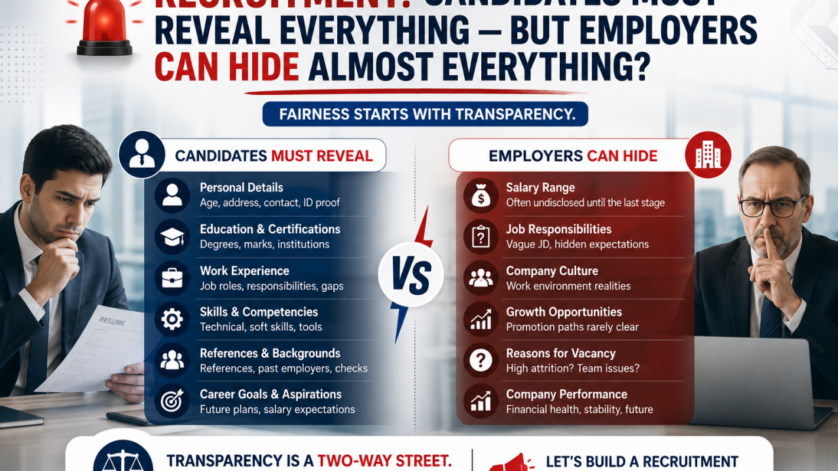
Let’s talk about one of the strangest double standards in modern recruitment.
When a candidate applies for a job, recruiters and headhunters may want to know almost everything:
Why did you leave your previous job? Why do you want to join us? What was your previous salary? What salary do you expect? Why was there a career gap? Are you willing to relocate? Tell us about your background. Tell us about yourself.
Candidates are expected to be transparent.
But then look at the job advertisement.
Company: Confidential Salary: Not disclosed Country: Sometimes unclear City: Not mentioned Exact location: Guess Interview location: We will tell you later Posted date: Missing Expiry date: Missing Hiring manager: Classified
So the candidate has to open the entire book of their professional life while the employer provides a job advertisement that looks like it was written by the CIA’s recruitment department. 😂
🔍 The Candidate Must Be Transparent. The Job Must Be a Mystery.
Recruiters may ask:
“What was your previous salary?”
Candidate:
“What is the salary range for this position?”
“We prefer to discuss that during the interview.”
Candidate:
“Where exactly is the job located?”
“We will explain during the process.”
Candidate:
“Which company is hiring?”
“We cannot disclose that yet.”
At some point the candidate has to wonder:
Am I applying for a job or participating in a treasure hunt?
Maybe the next vacancy will say:
Location: Somewhere on Earth. Salary: Competitive with someone else’s salary. Company: You will know when you know. Interview: Follow the clues. 😂
❤️ When Recruitment Becomes Too Personal
And then there are application forms that make candidates stop and ask:
“Wait… is this a job application or a relationship investigation?”
I have personally come across a Talabat application form that included a question asking whether the applicant had an affair and, if so, with whom.

If that question was indeed part of the application, it raises a serious question about where legitimate recruitment information ends and unnecessary intrusion into private life begins.
A candidate is applying for a job — not auditioning for a reality TV show.
If the job requires professional experience, qualifications, communication, integrity, teamwork or leadership, those are reasonable things to assess.
But asking about intimate personal relationships?
The candidate may reasonably think:
“Should I bring my CV, certificates and relationship history to the interview?” 😂
Maybe the next application form will say:
Previous salary? Expected salary? Reason for leaving? Relationship status? Name of affair partner? Favourite romantic memory?
At that point, the candidate might reasonably ask:
“Excuse me, am I applying for a job or writing Season 2 of my autobiography?” 😂
📅 Where Is the Posted Date and Expiry Date?
A serious job advertisement should tell candidates when it was published.
Was it posted yesterday?
Last week?
Last month?
And when does it close?
Without publication and closing dates, candidates don’t know whether they are applying for an active vacancy or an advertisement that has been sitting online longer than some employees have been in their current jobs.
Candidates shouldn’t have to become CSI: Recruitment just to determine whether a vacancy is still alive. 😂
🌍 If You Want a Local Hire, Say Where the Job Is
If an employer specifically wants someone in a particular country or city, the advertisement should clearly state the location.
Country.
City.
Area.
Worksite.
Eligibility.
This matters because location affects transportation, relocation, accommodation, visas, family decisions and whether the candidate can realistically accept the position.
If the vacancy appears in someone’s dashboard, it should not automatically create the impression that the employer is actively hiring locally.
Sometimes the algorithm is simply saying:
“You might like this job.”
That is not the same as:
“This employer wants you in your country.”
The difference should be clear.
🎯 The “Perfect Match” Problem
A candidate may have 15 years of experience, excellent results, leadership experience, operational knowledge and the qualifications required.
But one keyword is missing.
REJECTED.
Candidate:
“But I have actually done the job.”
ATS:
“That’s very interesting. Unfortunately, I only understand keywords.” 😂
Welcome to the Keyword Olympics.
😂 Sometimes They Are Looking for the Mole on Your Bottom
Candidates can meet 90%.
95%.
99%.
But some recruitment processes keep searching for that final 1%.
“Everything looks excellent… but does the candidate have the exact wording from line 17, paragraph 4, sentence 3?”
No?
NEXT!
At this rate, candidates may eventually receive:
“Please confirm whether you have a mole on your bottom. It wasn’t mentioned in the job description, but our recruitment matrix has a column for it.” 😂
Obviously, nobody is actually asking that.
But the joke makes a serious point:
People are not products manufactured to match a specification sheet.
Experience, judgment, adaptability, problem-solving and potential matter too.
🤖 The ATS Can Read Keywords — Can It Read Potential?
If companies can use ATS technology to screen candidates, why should candidates be criticized for using AI tools such as ChatGPT to improve their CV or cover letter?
If technology is acceptable on one side of the recruitment table, why is it suddenly unacceptable on the other?
Use technology.
Absolutely.
But use it to support human judgment, not replace it.
A CV is a document.
It is not the human being.
👔 HR Is Important — But HR Cannot Be the Judge of Everything
HR professionals play an important role in recruitment.
But HR cannot realistically be expected to determine every candidate’s technical or operational capability simply from keywords on a CV.
Someone who has never worked deeply in a particular operational function may not be able to distinguish between two candidates based purely on terminology.
Let the operational head judge the operator.
A warehouse manager should be assessed by someone who understands warehousing.
A logistics manager should be assessed by someone who understands logistics.
An IT professional should be assessed by someone who understands IT.
A finance professional should be assessed by someone who understands finance.
HR can assess communication, presentation, behavioural suitability, general recruitment criteria, language and coordination.
But specialized operational competence should be properly evaluated by people who understand the operation.
Otherwise, experienced professionals can be rejected simply because they didn’t know the secret password hidden inside the job description.
🖥️ The Application Website: The Candidate’s Final Boss
Now imagine this.
The candidate finds the vacancy.
Reads the description.
Researches the company.
Customizes the CV.
Redrafts the cover letter.
Completes the lengthy application form.
Enters employment history.
Enters education.
Adds certifications.
Answers screening questions.
Uploads documents.
Creates an account.
Verifies email.
Enters OTP.
Completes CAPTCHA.
Finally…
SUBMIT.
And then:
ERROR.
Try again.
ERROR.
Different browser.
ERROR.
Clear cache.
ERROR.
Try mobile.
ERROR.
Then:
“Your session has expired.”
Candidate:
“So has my patience.” 😂
If companies provide an application system, they should test it before asking thousands of candidates to use it.
The candidate should not become the company’s unpaid software tester.
🏦 Some Application Forms Feel Like a Bank Robbery
Security is important.
Candidate information must be protected.
But some application processes make candidates feel as though they are trying to break into the central bank.
Password:
One capital letter.
One lowercase letter.
One number.
One special character.
OTP.
Email verification.
CAPTCHA.
Another CAPTCHA.
Security question.
Session timeout.
Login again.
Verify again.
Upload again.
And finally:
“Please enter your mother’s maiden name.”
Candidate:
“I’m applying for Warehouse Manager, not trying to rob Fort Knox!” 😂
Security is necessary.
But security should not become an escape-room challenge.
⏰ Candidate Time Has Value
A serious candidate doesn’t simply click Apply.
They may spend hours:
- Reading the job description
- Researching the company
- Customizing the CV
- Redrafting the cover letter
- Adjusting relevant keywords
- Completing screening questions
- Entering employment history
- Uploading documents
- Completing lengthy forms
One properly prepared application can take significant time.
Now imagine doing that 10, 20 or 30 times.
Candidates don’t have unlimited hours.
They are looking for work.
They are not running a 24-hour job-application factory. 😂
So when a candidate submits fewer applications, it doesn’t necessarily mean they aren’t serious.
Maybe they are serious enough to customize every application properly.
📄 “Just Send Your CV”
“Just send your CV.”
If only it were that simple.
A serious candidate may customize their CV for a Warehouse Manager position, adjust it for a Logistics Manager position and modify it again for an Operations Manager position.
And then write a different cover letter.
And then complete a completely different application form.
So if one application takes an hour and the candidate applies to ten positions, that’s already 10 hours of work.
And if the website crashes on application number ten?
Congratulations.
You have just donated your entire day to somebody else’s IT department. 😂
🌐 Test the Website Before Saying “Too Many Applications”
Companies should ask themselves:
How many candidates tried to apply but couldn’t complete the application?
How many were lost because:
- The website crashed
- The submit button didn’t work
- The form timed out
- The CV wouldn’t upload
- The application wouldn’t save
- The system rejected a valid document
- The website wasn’t mobile-friendly
- The candidate received an error
Before launching a vacancy, someone should actually go through the application process as a candidate.
Click every button.
Upload a CV.
Complete the form.
Submit it.
Check the confirmation.
Try different browsers and devices.
Because if the final SUBMIT button doesn’t work…
you don’t have a recruitment process.
You have a digital decoration. 😂
📢 “Too Many Applications Received”
And then comes one of the most common messages:
“Due to the high volume of applications, only shortlisted candidates will be contacted.”
Well…
What did you expect? 😂
You published the vacancy everywhere.
You didn’t clearly identify the location.
You didn’t show the salary.
You didn’t provide a closing date.
You didn’t explain enough about the employer.
And then you opened the application door wide enough for a football stadium.
Now you’re surprised there are too many people inside?
You built the football-sized entrance. Don’t blame the footballers for coming in. 😂
🤝 Recruitment Should Be a Two-Way Street
This is not an attack on every HR professional.
There are excellent HR professionals and recruiters who communicate clearly, respect candidates and run professional recruitment processes.
The issue is one-sided transparency.
Candidates are told:
“Be transparent.”
Employers should also be transparent.
Candidates are asked about salary.
Employers should provide a realistic salary range where possible.
Candidates are asked why they left.
Employers should provide meaningful information about the vacancy.
Candidates are expected to respect interview schedules.
Employers should respect candidate time.
Candidates are expected to provide accurate information.
Employers should provide accurate job information.
🎯 Recruitment Is Not an Interrogation
Candidates are not the only people being evaluated.
Candidates evaluate employers too.
A job seeker is asking:
Can I do this job?
Do I want this job?
Is the company right for me?
Is the location practical?
Is the salary reasonable?
Is this worth my time?
These are legitimate questions.
So perhaps the next time a recruiter says:
“Tell me everything about yourself.”
The candidate can politely answer:
“Absolutely. And after that, could you tell me everything about the job?” 😉
Because recruitment should not be:
❌ An interrogation ❌ A treasure hunt ❌ A keyword Olympics ❌ A bank robbery ❌ An escape room ❌ A software-testing exercise ❌ A guessing game
It should be:
A PROFESSIONAL TWO-WAY EVALUATION
If candidates are expected to reveal their professional lives, employers should reveal the essential facts about the opportunity.
If candidates are expected to invest their time, recruitment systems should respect that time.
If employers want the best talent, they should make it easier for good talent to find them.
Recruitment needs less mystery and more transparency.
Because behind every application is not just a CV.
There is a human being who invested:
Time. Experience. Effort. Hope.
And sometimes…
three hours fighting your application website. 😂
So, HR and recruiters:
You don’t need to reveal your company secrets.
But please reveal enough for the candidate to know what they are actually applying for.
And candidates:
You don’t need to hide your professional value.
But you are also allowed to ask questions.
Because recruitment is not:
“You tell me everything, and I’ll tell you nothing.”
It should be:
“Let’s both be transparent and decide whether we are the right match.”
That is recruitment.
That is fairness.
And that is how we respect both sides of the table.