
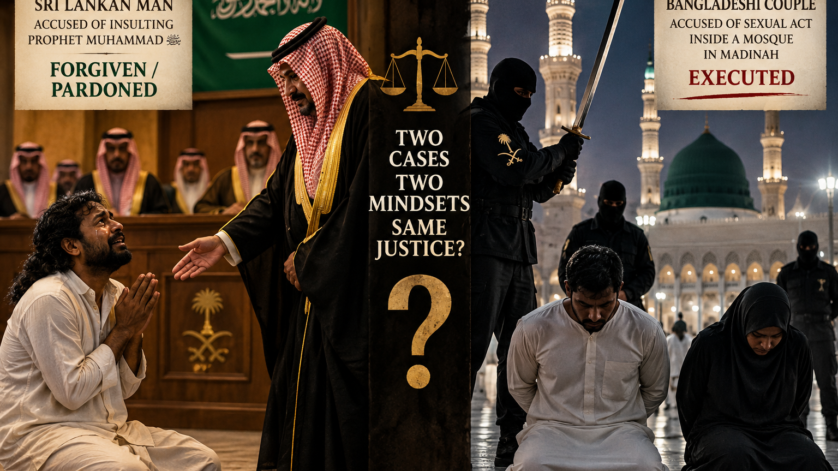
An editorial examination of mercy, capital punishment, religious sanctity, judicial transparency and the value of human life in Saudi Arabia.
October 17, 2026 | Justice • Human Rights • Religion • Rule of Law
There are moments when two judicial decisions, taken within days of each other, raise questions far beyond the courtroom. They force society to examine the meaning of justice, the boundaries of forgiveness, the responsibilities of religious authorities, and the power of the state over human life.
Saudi Arabia, the custodian of Islam’s two holiest mosques, finds itself at the center of precisely such a debate.
In one reported case, a Sri Lankan national facing a death sentence over allegations of insulting Prophet Muhammad ﷺ obtained a favorable judicial decision. In another, two Bangladeshi nationals were reportedly executed following convictions relating to an immoral act inside a mosque in the Makkah region.
The contrast is striking.
One case became associated with mercy and judicial intervention. The other ended with the irreversible punishment of death.
But the real issue is not whether two different offences should automatically receive identical punishments. They should not. The question is whether the legal reasoning, evidence, proportionality, appeals and opportunities for mercy were sufficiently clear and consistent in both cases.
And above all:
When the state exercises the power to take a human life, how much explanation does it owe the public?
1. The Sri Lankan case: A second chance at life
The reported Sri Lankan case concerned Anojan Sivarasa, whose death sentence was overturned by Saudi Arabia’s Supreme Court in October 2026 following legal and diplomatic efforts.
The allegations reportedly concerned insulting Prophet Muhammad ﷺ, an accusation treated with exceptional seriousness in Saudi Arabia’s religious and legal environment.
For Muslims, the Prophet is not merely a historical personality. He represents moral leadership, faith, compassion and the transmission of divine revelation.
Yet Islamic history also records examples of the Prophet responding to personal hostility with patience, restraint and forgiveness.
This raises an important distinction between protecting religious values and deciding the appropriate legal response to an alleged offence.
The Supreme Court’s reported intervention demonstrates the importance of judicial review. However, overturning a death sentence is not necessarily the same as granting an unconditional pardon or acquittal. The precise legal grounds and remaining status of the case matter.
Nevertheless, the central principle remains: a legal system must possess mechanisms capable of correcting, reconsidering or reversing the gravest punishments.
A second chance at life should never be regarded as a weakness of justice.
Sometimes it is justice functioning as intended.
2. The Bangladeshi case: When punishment becomes irreversible
The second reported case concerned two Bangladeshi nationals executed in Saudi Arabia in October 2026.
Reports described convictions involving an immoral act inside a mosque in the Makkah region. The publicly described allegations did not establish the precise sexual conduct, whether the individuals were married, or the full judicial reasoning behind the sentences.
These distinctions are essential.
The public should not turn an incomplete official description into a detailed accusation that has not been independently established.
There is also a geographical correction worth emphasizing: the reported case concerned the Makkah region, not Madinah’s Prophet’s Mosque.
The sanctity of a mosque deserves protection. A mosque is a place of prayer, reflection, education and spiritual discipline. Conduct that seriously violates its purpose can legitimately attract legal consequences.
But an equally important question remains:
Does every serious violation of religious sanctity justify the most severe punishment a government can impose?
The answer requires more than anger, emotion or religious slogans.
It requires evidence, clearly established law, proportionality and fair judicial procedures.
The execution of two people is not simply another administrative decision. It is final. There is no opportunity to restore their lives if evidence is later disputed, procedures are found defective, or the punishment is eventually judged excessive.
That irreversible nature creates a heightened duty of transparency.
3. Two cases, two outcomes: What do the facts actually show?

Sri Lankan national
Death sentence overturned

Two Bangladeshi nationals
Death sentences carried out
Illustrative photographs, not images of the individuals or actual court proceedings.
| Question | Sri Lankan case | Bangladeshi case |
|---|---|---|
| Allegation | Religious insult through a Facebook post | Unspecified immoral act inside a mosque |
| Judicial outcome | Death sentence set aside | Death sentences upheld and carried out |
| Date | October 13, 2026 | October 14, 2026 |
| Diplomatic involvement | Documented Sri Lankan legal and diplomatic intervention | Bangladesh reported lack of prior notification |
| Current position | Case reportedly subject to rehearing | Punishment irreversible |
Sri Lankan reporting indicates that Sivarasa’s case was returned for rehearing, not concluded with a complete acquittal. Meanwhile, the Saudi Interior Ministry stated that the Bangladeshi defendants had been convicted through judicial proceedings and that their sentences had been upheld.
The Morning
+2
These cases cannot be equated merely because both involved religion. The offences, applicable laws, evidentiary circumstances and procedural histories differ.
Nevertheless, comparing them is legitimate because both involve the state’s most severe punishment.
4. Islam teaches justice — but does it not also teach mercy?
The Qur’an repeatedly emphasizes justice, accountability and compassion.
In Surah An-Nahl (16:90), Allah commands justice and excellence in conduct. In Surah An-Nisa (4:58), believers are instructed to judge fairly between people.
And in Surah Az-Zumar (39:53), the Qur’an emphasizes the breadth of divine mercy and warns people not to despair of it.
These teachings must be understood within their proper religious and legal contexts. They do not mean that every criminal punishment must be forgiven or that all offences carry the same consequences.
But they do challenge the idea that severity alone demonstrates religious commitment.
The Prophet Muhammad ﷺ is remembered not only for establishing moral boundaries but also for showing restraint, accepting repentance and distinguishing personal grievances from matters requiring lawful judgment.
One of the most powerful lessons associated with his leadership is that strength does not always require retaliation.
A justice system does not become less Islamic because it exercises mercy. Nor does it automatically become more Islamic because it imposes the harshest available punishment.
The difficult responsibility is to distinguish between situations where punishment is necessary, where rehabilitation is possible, and where forgiveness serves a greater purpose.
5. The difference between Hudud, Ta’zir and judicial discretion
This is an important part of the discussion that is frequently overlooked.
Islamic jurisprudence distinguishes among categories of offences and punishments.
Hudud refers to offences for which classical Islamic jurisprudence recognizes specified punishments, subject to demanding legal and evidentiary requirements.
Qisas concerns retaliation for certain offences against persons, including homicide, with rules that may allow pardon or compensation.
Ta’zir refers to discretionary punishments determined by lawful authority for conduct not governed by a fixed punishment in the same manner.
The Bangladeshi case was reported as involving a death sentence under ta’zir.
The Daily Star
+1
This distinction matters enormously.
Where discretion exists, questions about the selection and proportionality of punishment become especially important.
If the law allows a range of penalties, what circumstances justified selecting death rather than imprisonment or another sanction?
Were mitigating factors considered? Was there a confession, forensic evidence or independent testimony? Were the accused represented by qualified lawyers? Did they understand the proceedings?
These are questions, not claims that the courts failed to perform those duties.
Without access to detailed judgments, outside observers cannot responsibly answer them.
But the absence of publicly accessible reasoning also makes it harder for society to evaluate the proportionality of the punishment.
6. Does protecting a mosque require taking a life?

A mosque is not an ordinary public building. It is a sacred environment in which worshippers expect dignity, respect and protection from misconduct.
Saudi Arabia has a legitimate responsibility to protect religious sites, worshippers and public order.
But there is a fundamental difference between defending the sanctity of a place and assuming that the most severe available penalty is necessarily the most appropriate.
A person may commit an offensive act inside a religious building. Depending on the conduct and the applicable law, punishment may be justified.
Yet proportionality requires the authorities to consider the seriousness of the act, the harm caused, the intent of the offender, the reliability of the evidence and the availability of less severe sanctions.
In the Bangladeshi case, the public description of the offence was too limited to permit an informed assessment of these factors.
That is precisely why a fuller explanation matters.
Respect for a sacred place and respect for human life should not be treated as competing religious obligations. Both deserve serious protection.
7. Why did diplomacy appear to matter in one case?
The Sri Lankan case highlights another issue: the role of diplomatic intervention.
Sri Lanka reportedly deployed legal specialists, coordinated with Saudi lawyers and pursued appeals. Its government publicly welcomed the Supreme Court’s decision.
This is evidence of an active effort to defend a citizen facing an extraordinarily serious sentence.
Daily Mirror
+1
The Bangladeshi case presents a different picture.
According to reporting published on October 17, Bangladesh’s consulate in Jeddah was still seeking formal clarification from Saudi authorities, including confirmation of the identities and nationality of those executed.
The Daily Star
This does not establish that diplomacy caused the different judicial outcomes. Nor does it establish that the Bangladeshi defendants lacked legal representation.
But it raises a wider concern about migrant workers and foreign nationals.
What happens when a person accused of a serious crime does not have the resources to employ experienced lawyers?
What happens when a diplomatic mission learns of an execution only after it has taken place?
And what happens when the defendant cannot communicate effectively in the language of the court?
A fair legal system should not make adequate representation dependent on a defendant’s personal wealth or the political influence of their home country.
8. The hidden vulnerability of migrant workers

Millions of foreign workers contribute to the economies of Gulf countries. They build infrastructure, maintain facilities, transport goods, clean public spaces, operate businesses and support households.
Yet many are unfamiliar with local laws, criminal procedures and their rights following arrest.
Some face language barriers. Others may lack the financial means to challenge an accusation or pursue an appeal.
This creates an important distinction between equality in written law and equality in practical access to justice.
A wealthy defendant may be able to hire experienced counsel, commission expert evidence and pursue every available legal remedy.
A low-income worker may struggle to understand even the first stage of proceedings.
That difference does not prove that any particular court discriminated. It demonstrates why procedural safeguards are so important.
Justice must not only be available in principle. It must be accessible in practice.
A passport should identify a person’s nationality, not determine the quality of justice that person receives.
9. What does the international community have a right to question?
Saudi Arabia is a sovereign state with its own legal system and religious traditions. Foreign governments and commentators should recognize that different societies maintain different legal frameworks.
But sovereignty does not remove every obligation to explain the exercise of state power.
Particularly in capital cases, internationally recognized fair-trial principles emphasize competent legal representation, meaningful appeal, adequate interpretation, reliable evidence and protection against arbitrary deprivation of life.
International human-rights standards also call for severe restrictions on the use of capital punishment, with the strongest protections reserved for defendants facing execution.
The debate therefore need not become an attack on Islam, Saudi citizens or Saudi culture.
It can instead be a principled discussion about the conduct of public institutions.
A government that believes its decisions are lawful should be able to explain the relevant law and judicial reasoning, while protecting legitimate privacy and security interests.
Public accountability can strengthen the credibility of institutions rather than weaken them.
10. Is justice about fear, correction or rehabilitation?
Societies punish wrongdoing for several reasons: protecting the public, deterring future offences, expressing condemnation and, where possible, rehabilitating offenders.
But punishment should not become a competition in severity.
If a sentence is so severe that it removes every possibility of correction or rehabilitation, the justification for that sentence deserves especially careful scrutiny.
Capital punishment is unique because it permanently eliminates the opportunity to correct a wrongful conviction.
An overturned prison sentence can lead to release. Financial compensation may partially address certain injustices. A retrial can reconsider disputed evidence.
An execution cannot be reversed.
This is why transparency before execution is far more important than explanation afterward.
11. What Saudi Arabia could do to strengthen public confidence

The two cases suggest several practical areas in which greater transparency could strengthen trust.
- Publish clearer judicial summaries: Explain the offence, applicable law, aggravating circumstances and reasons for selecting a particular sentence.
- Strengthen consular notification: Ensure foreign diplomatic missions receive timely information consistent with applicable international obligations.
- Guarantee interpretation and legal representation: Particularly for defendants who cannot afford counsel or understand Arabic proceedings.
- Explain discretionary sentencing: Where ta’zir is used, clarify why the selected punishment is proportionate.
- Provide meaningful opportunities for review: Ensure capital cases receive especially rigorous judicial scrutiny and access to appropriate clemency procedures.
- Improve public reporting: Release enough verified information to prevent rumors without unnecessarily exposing victims, witnesses or families.
None of these reforms requires abandoning religious principles.
They are consistent with the broader objectives of fairness, accountability and protection against wrongful punishment.
12. The deeper moral question: Whose life matters?
The most troubling aspect of the comparison is not simply that one defendant avoided execution while two others did not.
It is the possibility that public attention, diplomatic influence and access to legal resources may vary dramatically between defendants.
We must be careful not to declare that such differences determined these particular outcomes without evidence.
But we should be equally careful not to ignore the structural question.
Imagine two foreign workers arrested in the same country.
One has lawyers, diplomatic support, media attention and a government actively pursuing the case.
The other has limited resources, little public visibility and family members who may not understand the legal system.
Even if both courts follow the law, their practical opportunities to defend themselves may be very different.
That is why justice must be evaluated not only at the moment a verdict is announced, but throughout the entire process.
The right to a fair hearing must begin at arrest, continue through investigation and trial, and remain meaningful during appeal.
Equality before the law is incomplete without equality of access to its protections.
Conclusion: Justice should have one standard, even when the offences differ

Symbolic illustration of justice, mercy and accountability.
The Sri Lankan and Bangladeshi cases should not be reduced to a slogan claiming that Saudi Arabia simply forgives one nationality and executes another.
The known facts do not establish such a conclusion.
What they do establish is that, within a remarkably short period, Saudi Arabia’s judicial system produced two dramatically different outcomes in cases involving religiously sensitive allegations.
In one, the Supreme Court intervened to set aside a death sentence. In the other, two people were executed under a discretionary punishment after authorities cited the seriousness of an offence committed inside a mosque.
The public deserves to understand the legal reasoning behind decisions of such gravity.
The families deserve clarity.
Foreign nationals deserve fair procedures and effective access to legal assistance.
And religious institutions deserve protection through laws that are transparent, proportionate and consistently applied.
A society should be able to defend the sanctity of its religious places without treating questions about judicial proportionality as disrespectful.
Likewise, criticism of a particular sentence should not automatically be interpreted as approval of the alleged conduct.
The measure of justice is not how severely a government can punish. It is how fairly, carefully and consistently it exercises its power — especially when a human life is at stake.
The final question is therefore not whether Saudi Arabia should choose mercy over justice.
It is whether its justice system can demonstrate that mercy, due process and proportionality are available to everyone under the same principled standards.
Hashtags
#SaudiArabia #JusticeForAll #HumanRights #RuleOfLaw #EqualJustice #IslamicJustice #MercyAndJustice #DeathPenalty #JudicialTransparency #MigrantWorkers #SriLanka #Bangladesh #FairTrial #LegalRights #HumanDignity #ReligiousSanctity #Accountability #GCC #SocialJustice #PeoplePair
Editorial note: This article distinguishes reported facts from commentary and unanswered questions. It does not assert that either case was decided unlawfully, nor that the two cases involved legally equivalent offences. Reporting reviewed through October 17, 2026.
Two Cases, Two Mindsets — One Kingdom. Is Justice Equal for Everyone?
One death sentence overturned, two executions carried out. Two different cases, two dramatically different outcomes — raising important questions about justice, mercy, proportionality, and equality before the law.
I invite you to read the full article and share your valuable opinions. Is justice measured by the severity of punishment or by fairness, transparency, and consistency?
Let’s discuss respectfully, objectively, and without religious or national prejudice.
#JusticeForAll #SaudiArabia #HumanRights #IslamicJustice #MercyAndJustice #EqualJustice #RuleOfLaw #PeoplePair