
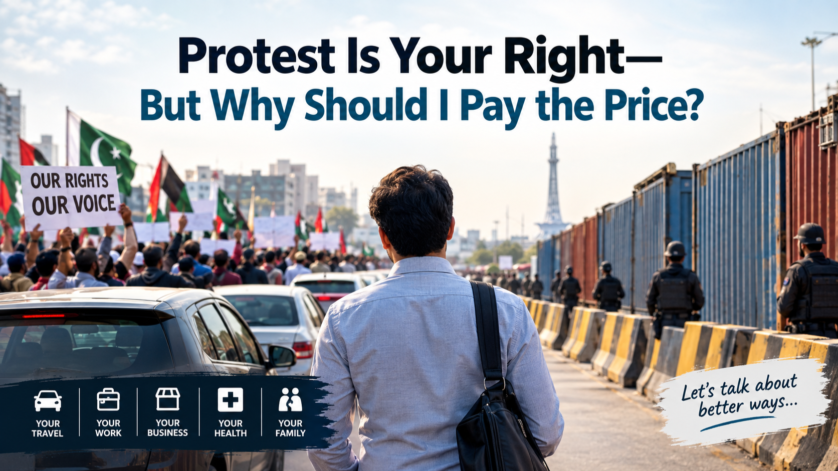
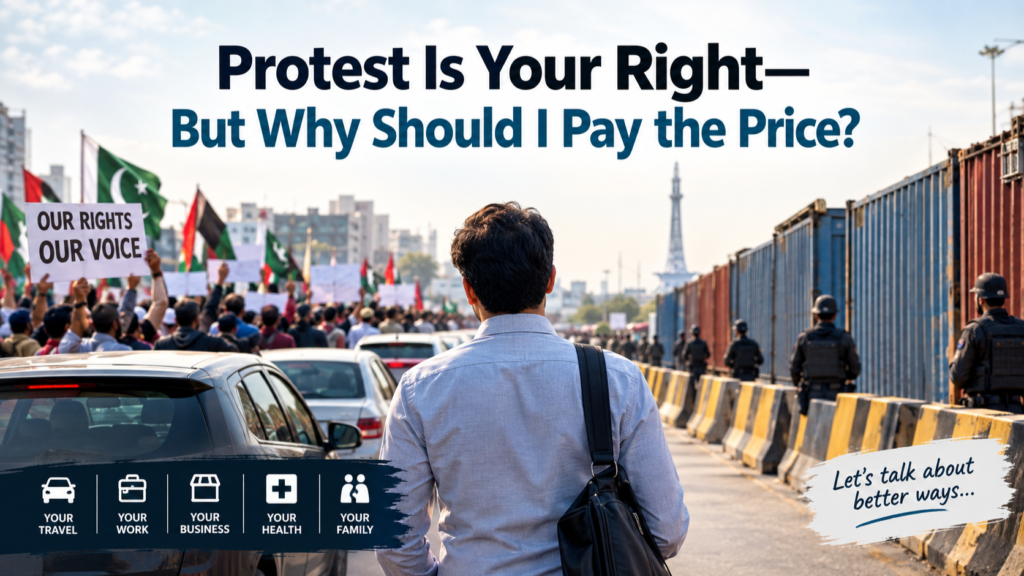
Protest Is Your Right—But Why Should I Pay the Price?
I am an ordinary citizen. I did not call for the protest. I did not organize the jalsa. I did not choose the dharna. So why should my entire day, my work, my business, my travel, or even my safety be affected because someone else has chosen to protest—or because the government has chosen to stop that protest?
This is the question that needs to be asked.
In Pakistan, whenever there is a jalsa, protest, dharna, procession or demonstration, the same situation often develops. Protesters block roads to make their voices heard, while the government puts containers, barriers and roadblocks in place to stop them.
One side blocks the road to protest. The other side blocks the road to stop the protest. And in both cases, it is the ordinary citizen who pays the price.
But there is another question we also need to ask:
Why do people come onto the roads in the first place?
Perhaps one reason is that we have not learned how to properly accept differences of opinion.
Whether it is in Parliament, in a court case, inside a company, within an organization, or even among ordinary people, we often struggle to accept the opinion of the other side.
We want our decision to be accepted, but we do not always give the same importance to the opinion of our opponent.
When people feel that their basic rights are being disregarded, that their voice does not matter, or that there is no meaningful place for their opinion to be heard, frustration can eventually move from institutions to the streets.
That does not mean blocking roads, damaging property, creating public disorder or putting ordinary citizens in danger should become acceptable.
People have the right to protest peacefully and legally. But protest should not mean stopping the lives of millions of people who have nothing to do with the dispute.
This Practice Must Come to an End
There has to be a better way.
The government should not have to turn every major road into a wall of containers whenever a protest is expected. At the same time, protesters should not have to occupy public roads and bring an entire city to a standstill to make their point.
If people have a disagreement, there are courts, Parliament, legal procedures and other lawful forums through which their position can be presented.
And if people choose to protest, they should do so legally—without blocking everyone else’s way, damaging property, burning things or creating danger for innocent people.
What About the Ordinary Citizen?
Think about the person who has nothing to do with the protest.
Someone may need to:
- Drop or collect a family member from the airport.
- Travel for an important business meeting.
- Reach work on time.
- Take a child to school or bring them home.
- Reach a hospital.
- Call an ambulance.
- Get to an emergency.
- Attend an important appointment.
- Simply move from one part of the city to another.
When roads are blocked, even basic movement can become a serious problem.
Imagine an ambulance unable to move through a blocked road. Imagine a person suffering an accident while traffic is completely stuck. Imagine someone trying to make an emergency phone call or communicate with family when normal movement and communication are disrupted.
These are not political issues for that person.
That person is simply trying to live.
There have also been concerns and reported situations where people in medical emergencies have struggled because roads were blocked. These are the moments when we have to ask ourselves: Is our method of protest causing suffering to people who have absolutely nothing to do with our disagreement?
The Same Principle Should Apply to Religious Processions
The same consideration should apply to religious processions and other large public gatherings.
People should have the freedom to observe their religious events, but major processions moving from one location to another through busy public roads can also create serious disruption for ordinary citizens.
A practical solution could be to arrange designated locations where such gatherings can take place safely, with proper security and facilities provided by the government, rather than allowing major public roads to become inaccessible for long periods.
The principle should be the same for everyone.
Your belief, your protest and your gathering should not require an innocent person to sacrifice their basic right to move freely.
The Government Also Has a Responsibility
If the government wants to prevent disruption, simply putting containers everywhere cannot be the permanent solution.
There should be a system in which people can express their disagreement, present their demands and challenge decisions through lawful channels.
At the same time, when someone deliberately chooses to participate in an unlawful disruption, the consequences should be clear and properly enforced according to the law.
My personal suggestions are:
- On the same day, if someone is absent from duty without any genuine cause, they should be fired, and attendance on that day should be mandatory.
- If anyone closes their business and is caught participating in the protest, the government should seal their business.
- If someone is caught participating in the protest, the government should seal their property.
- Anyone caught participating should be placed under a travel ban.
- There should be restrictions on obtaining loans.
- And similar measures should be considered.
The purpose of such measures, from this point of view, would be to make people think carefully before deliberately disrupting public life.
But There Is a Bigger Lesson
Perhaps the real problem is not only the protest.
Perhaps the deeper problem is that we need to learn how to listen to each other.
If a person disagrees with a decision, there should be a meaningful way for that disagreement to be heard.
If an opponent has an argument, it should be considered.
If someone believes their rights have been ignored, there should be a lawful mechanism through which they can challenge that decision.
And if those mechanisms are trusted and respected, perhaps fewer people will feel that the only way to be heard is to come onto the road.
At the same time, the answer cannot be to make ordinary citizens suffer until the dispute is resolved.
I Am an Ordinary Citizen Too
I have the right to work.
I have the right to travel.
I have the right to run my business.
I have the right to reach a hospital.
I have the right to call for emergency help.
I have the right to move freely.
And I have the right to live my normal life without becoming a victim of somebody else’s political, organizational or personal dispute.
Protest is your right.
Expressing disagreement is your right.
Having a different opinion is your right.
But my basic rights matter too.
The government should find a way to protect the public without turning cities into container barricades.
Protesters should find a way to make their voices heard without turning public roads into protest grounds.
And all of us need to learn that having the right to speak does not mean having the right to make innocent people suffer.
Now I Want to Ask the Public
What do you think?
Why do people feel they have to come onto the roads to make themselves heard?
Is the real problem only the protest—or is it also our failure to listen to the other side?
How can people exercise their right to protest without taking away the ordinary citizen’s right to live, work and travel?
And most importantly:
Do you agree with the main point of this article—that your right to protest should not become an ordinary citizen’s suffering?
What is your opinion?