
SOCIAL PSYCHOLOGY | JUSTICE | HUMAN BEHAVIOR | SOCIETY
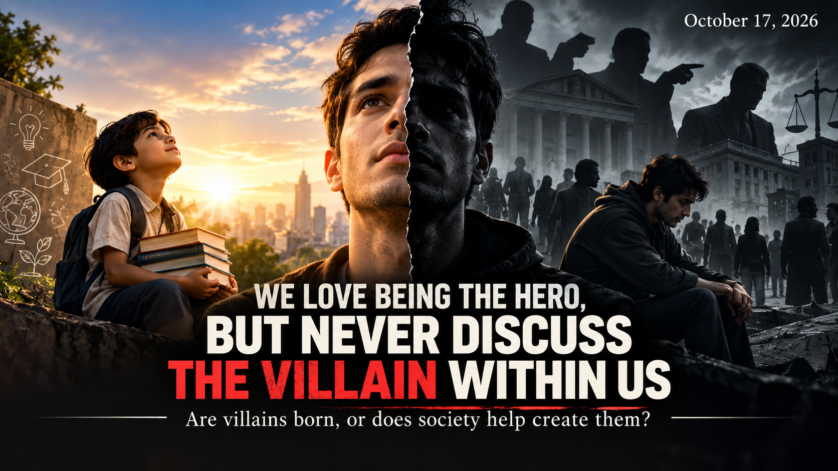
We Love Being the Hero, but Never Discuss the Villain Within Us
Are terrorists born, or does society sometimes help create the conditions that turn ordinary human beings toward violence? And who is responsible for the story behind the story?
October 15, 2026
1. Everyone Wants to Be the Hero of Their Own Story
Have you ever noticed something strange about human behavior?
We love discussing stories in which we are the hero, the victim, the savior, or the innocent person. We proudly describe our sacrifices, our struggles, our kindness, and the injustices committed against us.
But how often do we discuss the stories in which we ourselves are the villain?
Almost never.
A father describes how much he sacrificed for his children, but rarely discusses the emotional wounds he may have caused them.
A manager proudly explains how he built a successful company, but rarely talks about the employees whose dignity he destroyed along the way.
A government celebrates its victories, but may avoid discussing the suffering caused by its own decisions.
And a society condemns the criminal standing before it, without always investigating the circumstances that shaped his journey.
We are interested in the crime, but often uninterested in the history of the criminal.
That is where our understanding of human behavior begins to fail.
2. Terrorist, Freedom Fighter, or Fidayeen — Who Decides the Label?


7
Consider three words: terrorist, freedom fighter, and fidayeen.
One person may be celebrated by a community as a defender, while another community sees that same person as a dangerous attacker.
History, politics, identity, and personal suffering can influence how people describe an armed struggle.
But labels alone cannot determine whether an act is justified. Deliberately attacking civilians, kidnapping children, or committing sexual violence remains wrong regardless of the cause claimed by the perpetrator.
Now consider the question we often fail to ask:
What happened before this person picked up a weapon?
Imagine a man who once lived an ordinary life.
He had parents, a wife, children, a home, a business, livestock, and dreams for the future.
One day, armed men attack his village.
His children are killed. His wife or daughter is sexually assaulted. His property is seized. His business is destroyed.
He approaches the police, but nobody listens.
He visits government offices, but nobody acts.
He appeals to influential people, but they turn him away.
He seeks justice for years, only to encounter humiliation, corruption, threats, and silence.
Eventually, somebody approaches him and says:
“The system will never give you justice. Come with us, and we will give you revenge.”
This is a dangerous turning point.
The person who recruits him may present violence as dignity, revenge as justice, and death as heroism.
But revenge against innocent people does not restore the lives already lost. It creates new victims and new grievances.
We must ask not only who recruited him, but also who abandoned him before the recruiter arrived.
3. Was He Born a Terrorist?

Look at a newborn child.
Does that child understand terrorism, revenge, political ideology, religious extremism, or ethnic hatred?
No.
A child enters the world dependent on the people and institutions around him.
His mother teaches him affection.
His father works to provide food, shelter, and education.
His teachers teach him language, mathematics, discipline, and moral responsibility.
His family spends some of the most productive years of their lives trying to give him a better future.
Then he enters the wider world.
There he may encounter discrimination, exploitation, injustice, violence, humiliation, or propaganda.
The question becomes:
If the family planted the seeds of humanity, who introduced the poison of hatred?
The answer is rarely one person.
Violent radicalization has multiple pathways. Some individuals are influenced by trauma or injustice, others by ideology, identity, peer pressure, coercion, status, or organized recruitment. Most people who suffer terrible injustice never become terrorists.
Therefore, we should not assume that every violent extremist was previously an innocent victim, or that suffering automatically produces terrorism.
Yet we should investigate how social conditions and individual choices interact rather than pretending that violent extremism appears from nowhere.
4. The Invisible Villains Behind the Visible Villain

When an individual commits an act of violence, society immediately asks:
Who is he? Where did he come from? What religion does he follow? Who trained him? Which organization does he belong to?
These are legitimate questions.
But another set of questions deserves attention.
Who destroyed his family?
Who illegally occupied his land?
Who refused to register his complaint?
Who accepted a bribe?
Who protected the original offenders?
Who exploited his anger?
Who supplied the weapons?
Who convinced him that innocent strangers deserved punishment?
And who benefited from the resulting violence?
The original offender, the corrupt official, the extremist recruiter, and the person who ultimately attacks civilians may all have different forms of responsibility.
Investigating these layers is not an attempt to excuse the attacker. It is an attempt to understand and interrupt the entire chain.
Punishing the last person in the chain without examining the earlier failures may leave the machinery of violence untouched.
5. Society as a Factory: What Are We Producing?
Consider society as a production system.
Parents supply the foundation.
Schools provide knowledge.
Communities shape belonging.
Employers influence dignity and economic opportunity.
Religious and political leaders influence values and identity.
Police and courts are supposed to protect rights and provide justice.
Governments establish the conditions under which these institutions operate.
What happens when this system becomes defective?
A POSSIBLE PATHWAY TOWARD VIOLENCE
Ordinary person with hopes and responsibilities
Severe injustice, loss, or humiliation
Repeated institutional failure and isolation
Extremist recruitment and manipulation
A choice: reject violence or participate in it
This is one possible pathway, not a universal explanation or an inevitable progression.
In an industrial factory, when a defective product appears, responsible managers investigate the entire production process.
They inspect the materials, machinery, procedures, supervision, and quality controls.
Why should we examine human tragedies with less seriousness?
We should investigate the institutions that failed, while recognizing that human beings are not factory products. They retain agency, moral responsibility, and the ability to make different choices.
6. The Tragedy of Selective Sympathy

When violence strikes our own community, we call it a tragedy.
When it strikes a community we dislike, some people become silent, minimize the suffering, or search for excuses.
We recognize the tears of our own mothers but overlook the tears of other mothers.
We demand justice for our children but sometimes fail to extend the same principle to someone else’s children.
This selective sympathy is one of the most destructive weaknesses in human society.
A child killed in an attack does not become less innocent because of nationality, religion, ethnicity, or political identity.
A woman subjected to sexual violence does not become less deserving of justice because she belongs to the opposing side.
Human rights cannot depend on whether the victim belongs to our team.
If we condemn cruelty only when it happens to us, we are not consistently defending humanity. We are defending our identity.
7. The Most Dangerous Person May Never Hold a Weapon
Sometimes the person who commits violence becomes the public face of evil, while the people who encouraged, financed, protected, or manipulated him remain far from the consequences.
A powerful figure may spread hatred without personally attacking anyone.
A recruiter may exploit a grieving teenager without risking his own family.
A corrupt official may deny justice without ever appearing on a battlefield.
Their responsibility must be established through evidence, not assumptions. But their possible involvement should not be ignored simply because someone else carried out the final act.
This raises an uncomfortable question:
Are we identifying everyone responsible, or merely punishing the person easiest to see?
8. Justice Must Arrive Before Revenge Becomes Attractive

Preventing terrorism cannot depend exclusively on soldiers, intelligence agencies, prisons, and border security.
Security measures may be necessary to stop immediate threats. But long-term prevention also requires functioning institutions.
A person whose home has been stolen must have a realistic legal remedy.
A family whose children have been killed must receive a credible investigation.
A survivor of sexual violence must receive protection, dignity, and justice.
Young people must have opportunities to question propaganda and seek help without fear.
Communities must have trusted ways to resolve grievances before extremist recruiters exploit them.
And people who have already been drawn into violent movements need appropriate opportunities to disengage, where safety and accountability permit.
Justice is not a guarantee that nobody will choose violence.
But when lawful remedies are inaccessible, the people offering unlawful revenge can find an audience.
9. We Need the Courage to Discuss Our Own Villainous Roles
This brings us back to the original question.
Why do we love stories in which we are heroes, but avoid discussing stories in which we may be villains?
Because being the hero protects our self-image.
Being the villain demands accountability.
It is easier to condemn the angry man than investigate whether our institutions ignored his suffering.
It is easier to praise our own sacrifices than acknowledge the pain our decisions caused others.
It is easier to celebrate victory than count every innocent life lost on the way.
And it is easier to blame the next generation than examine the world we handed over to them.
This does not mean every accusation against society is correct, or that every criminal can blame circumstances for his choices.
It means mature societies must be capable of examining their own failures without abandoning personal responsibility.
Conclusion: Before Asking Who Became a Monster, Ask What Happened Along the Way

Somewhere, a mother may still remember the first day she sent her son to school.
A father may remember working overtime to pay his fees.
A teacher may remember the boy who once wanted to become a doctor, engineer, businessman, or teacher himself.
Years later, that same boy might appear on television accused of a terrible act.
The public sees the adult.
His parents remember the child.
The court examines his actions.
But society must also examine the journey.
What happened between the classroom and the battlefield?
What happened between the family dinner and the extremist recruitment camp?
Which opportunities were lost? Which grievances were ignored? Which ideas were deliberately planted? Which choices did he make?
And, most importantly, could someone have intervened before another family was destroyed?
Understanding the journey is not forgiving the crime. Explaining the causes is not justifying the consequences.
The person who commits an atrocity must be held accountable. So must those who organize, enable, or unlawfully contribute to it.
But if we want to prevent the next tragedy, we cannot stop investigating at the moment the weapon was fired.
We must also investigate the years before it.
Because the most important question is not merely:
“Who pulled the trigger?”
It is also:
“Who failed to stop the suffering, who exploited it, and what must change so that another human being does not follow the same path?”