
Science, Discovery & Invention: Understanding the Difference
When we say that science discovered something or that science created something, we often mix together three different concepts: science, discovery, and invention.
Understanding the difference raises an interesting question:
Does science actually create the fundamental substances it studies, or does it study what already exists and use that knowledge to develop something new?
What Is Science?
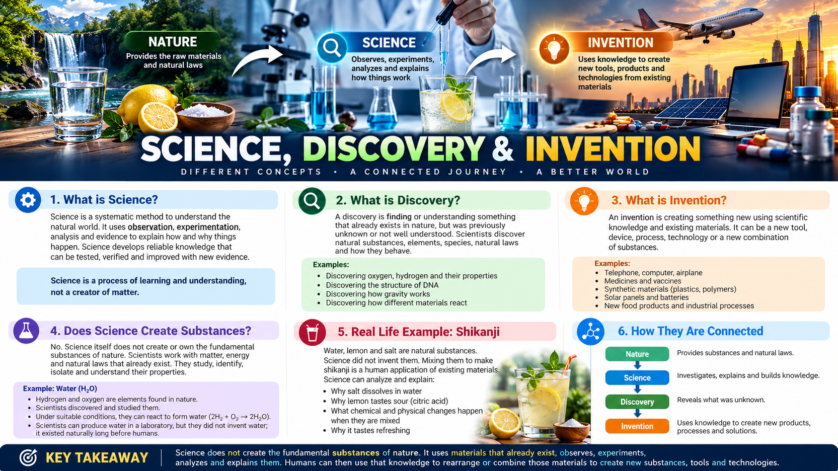
Science is fundamentally a systematic method of understanding the natural world.
It involves:
Observation → Question → Experiment → Analysis → Evidence → Conclusion → Further Testing
Science observes phenomena, investigates them through experiments and measurements, analyzes the results, and develops explanations for how and why things happen.
Therefore, science itself should not be confused with the substances, objects, or natural laws that it studies.
Discovery: Finding What Already Exists
A discovery occurs when humans identify or understand something that already exists but was previously unknown or insufficiently understood.
For example, humans did not invent hydrogen or oxygen. Scientists identified these elements, studied their properties, and learned how they behave.
Similarly, gravity was operating before humans understood it. Scientific investigation helped humanity describe and understand it.
So, in simple terms:
Discovery reveals what was already there.
Invention: Using Knowledge to Create Something New
An invention is different.
Humans can take existing materials and scientific knowledge and rearrange, combine, process, or engineer them into something new.
Computers, airplanes, engines, solar panels, medicines, plastics and countless other technologies are examples of human invention and engineering.
The important distinction is that the inventor does not need to create the fundamental matter from nothing.
Instead:
Existing matter + knowledge + human design = new invention
Consider Water: H₂O
Water provides a simple example.
Hydrogen and oxygen are naturally occurring elements. Scientists did not invent their fundamental existence.
Under suitable conditions, hydrogen and oxygen can react to form water:
2H₂ + O₂ → 2H₂O
Scientists can perform this reaction and produce water experimentally.
But producing water through a reaction does not mean that science invented water. Water existed naturally long before modern science and even before human civilization.
Science discovered and explained its composition and the processes through which it can form.
A Simple Everyday Example: Shikanji
Consider something even more familiar:
Water + Lemon + Salt → Shikanji
Science did not invent the fundamental existence of water, lemons, or salt.
A person can combine these existing materials to prepare a drink.
Science, however, can investigate and explain what is happening:
Why does salt dissolve?
Why does lemon taste sour?
Which compounds are present in lemon juice?
What physical and chemical changes occur when the ingredients are mixed?
This demonstrates the distinction very clearly.
The materials exist. Humans combine them. Science can investigate and explain what happens.
Can Scientists Create New Substances?
Yes—but this requires an important clarification.
Scientists and engineers can synthesize compounds and materials that may not previously have existed in that particular form.
They can rearrange atoms and molecules to produce new medicines, polymers, alloys, electronic materials and many other substances.
But even here, they are working with existing matter, energy and the laws governing nature.
They are not creating the fundamental building blocks of nature from absolute nothingness.
Science Is a Method, Not the Material It Studies
This is perhaps the most important distinction.
Science is not water. Science is not hydrogen. Science is not oxygen. Science is not an atom.
Science is the method through which humans investigate, test and understand these things.
Scientific knowledge can then be applied through engineering and technology to transform existing materials into incredibly sophisticated inventions.
A useful way to summarize the relationship is:
NATURE → provides matter, energy and phenomena
SCIENCE → observes, experiments, analyzes and explains
DISCOVERY → reveals something previously unknown
KNOWLEDGE → develops from evidence and understanding
INVENTION → applies knowledge to create new arrangements, tools and technologies
Final Thought
Science has given humanity an extraordinary ability to understand the universe.
But understanding something, discovering something, and inventing something are not identical concepts.
Science investigates what exists. Discovery reveals what was unknown. Invention uses knowledge and existing resources to create something new.
That distinction makes the achievements of science no less remarkable—it simply helps us understand more precisely what science actually does.