
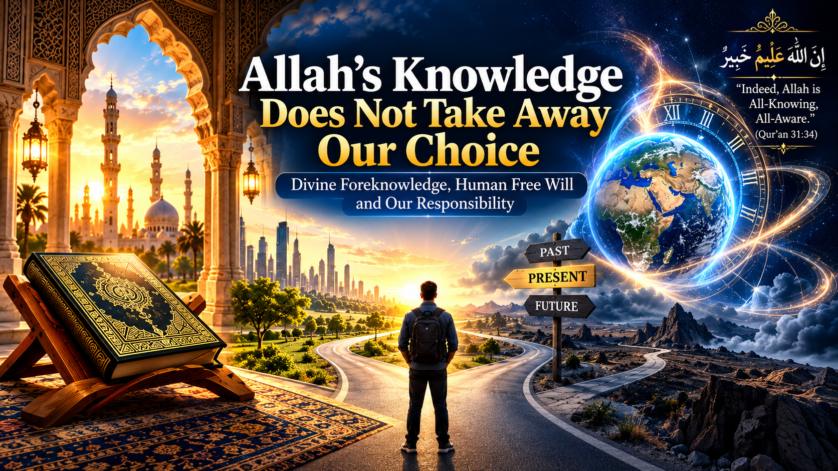
Allah’s Knowledge of the Future: Knowing Is Not the Same as Forcing
Understanding Divine Foreknowledge, Human Choice, Destiny and Responsibility in Islam
One of the deepest questions about faith, destiny and human freedom is this:
If Allah already knows everything that will happen in the future, are our lives already decided?
If Allah knew before our birth whether we would believe or disbelieve, obey or disobey, succeed or fail, earn halal or haram, and ultimately enter Paradise or Hell—then a natural question follows:
Are we actually making our own choices, or are we simply acting out something Allah has already written?
Islam makes an important distinction that is sometimes overlooked:
Allah knowing what you will choose is not the same as Allah forcing you to choose it.
Understanding the difference between knowledge and compulsion is essential to understanding Qadar—divine decree.
Allah’s Knowledge Is Not Limited by Human Time
Human beings experience existence sequentially:
Past → Present → Future
Yesterday has already happened. We are experiencing today. Tomorrow remains unknown to us.
Because this is how we experience time, we naturally imagine knowledge in the same way. We learn something after information becomes available to us.
But Islamic theology does not describe Allah’s knowledge this way.
Allah does not wait for tomorrow to arrive before knowing tomorrow.
The Qur’an repeatedly describes Allah’s knowledge as encompassing everything.
“Indeed, Allah has knowledge of all things.”
— Qur’an 31:34
Therefore, what is “future” from our perspective is not something Allah must wait to discover.
Allah knew us before we were born. He knows us now. He knows every decision we will make and every consequence that will follow.
His knowledge does not increase when an event occurs.
The Qur’an Gives a Powerful Example
Surah Luqman states:
وَمَا تَدْرِي نَفْسٌ مَّاذَا تَكْسِبُ غَدًا
“No soul knows what it will earn tomorrow.”
— Qur’an 31:34
A person can certainly make plans for tomorrow.
Someone may say:
“Tomorrow I will go to work.”
Another might say:
“Tomorrow I will sign a contract.”
A student may say:
“Tomorrow I will take my examination.”
These are plans, expectations and predictions based on current circumstances.
But none of these people possesses absolute knowledge of what tomorrow will actually bring.
Allah does.
The same verse continues:
وَمَا تَدْرِي نَفْسٌ بِأَيِّ أَرْضٍ تَمُوتُ
“And no soul knows in what land it will die.”
We may choose where we live. We may book tomorrow’s flight. We may plan our retirement twenty years ahead.
Yet we cannot know with absolute certainty where our final moment will occur.
This is the distinction between human expectation and divine knowledge.
If Allah Knows My Decision, Am I Really Free?
This is where the question becomes more philosophical.
Suppose tomorrow you face two possible choices:
A — tell the truth
or
B — tell a lie.
Allah already knows which one you will choose.
But ask a different question:
When tomorrow arrives, who actually makes the choice?
You do.
You think.
You consider the alternatives.
You form an intention.
And you act.
Allah’s prior knowledge does not require you to experience yourself as being physically or mentally forced into that decision.
This gives us the critical distinction:
Knowing an action ≠ causing someone to perform that action.
Allah’s knowledge is perfect, but knowledge itself should not be confused with coercion.
A Simple Example: The Teacher and the Examination
Consider a teacher who knows his students extremely well.
One student studied throughout the year. Another repeatedly refused to study.
The teacher might predict:
“Ahmed will probably pass, and Zaid will probably fail.”
Suppose the prediction proves correct.
Did the teacher’s knowledge cause Ahmed to answer correctly?
No.
Did the teacher physically force Zaid to give incorrect answers?
No.
The students performed their own actions.
Of course, this analogy has an important limitation:
A teacher merely predicts and can be wrong. Allah’s knowledge, in Islamic belief, is perfect and cannot be wrong.
So the analogy does not explain how divine knowledge works. It illustrates only one logical distinction:
Knowledge of an action and forcing an action are not the same thing.
But Allah Has Already Written Everything
Islam goes further than saying Allah merely knows the future.
The Prophet Muhammad ﷺ taught that Allah had written the decrees of creation before the creation of the heavens and the earth. This forms part of the Islamic doctrine of Qadar.
That raises the stronger question:
If it was already written, how can I be free?
The answer again requires distinguishing recording what Allah knows from forcing the human decision.
From the Islamic perspective, Allah did not write something because He was uncertain and then decide to force humans to make His prediction come true.
Rather, Allah knew what His creatures would do, and it was written according to His perfect knowledge.
The writing does not surprise Allah when it becomes reality.
But neither should it be imagined as a script that a human being reads and helplessly performs.
You do not know what has been written for you.
You encounter choices.
You make decisions.
And you are judged according to those decisions.
You Cannot Use Qadar as an Excuse for Sin
This point is extremely important.
Imagine someone steals money and then says:
“Allah already wrote that I would steal it, so it isn’t my responsibility.”
That reasoning does not work.
Why?
Because before stealing the money, the person did not have access to the divine decree telling him:
“You must steal this.”
What he actually experienced was a choice:
Take it — or leave it.
He chose to take it.
The hidden decree cannot therefore be used afterward as an excuse for a voluntary action.
Interestingly, people rarely use this logic consistently.
A person who steals your wallet cannot reasonably tell you:
“Don’t blame me. It was Qadar.”
while simultaneously objecting when someone steals his wallet.
Our everyday moral reasoning recognizes that choices matter.
Allah’s Knowledge Includes Our Choices
Sometimes the problem arises because we imagine only two possibilities:
Either:
Allah controls everything, therefore humans have no meaningful choices.
Or:
Humans make choices, therefore Allah cannot know them beforehand.
Islam does not accept this forced either/or.
Allah created human beings with the capacity to intend and choose, while Allah’s knowledge encompasses those choices.
The Qur’an says:
“So whoever wills—let him believe; and whoever wills—let him disbelieve.”
— Qur’an 18:29
And elsewhere:
“For whoever among you wills to take a straight path.”
— Qur’an 81:28
The following verse immediately places human willing within Allah’s greater sovereignty:
“But you cannot will unless Allah, Lord of all worlds, wills.”
— Qur’an 81:29
So the Qur’anic picture contains both human willing and divine sovereignty.
They are not treated as mutually exclusive.
Allah Knew Us Before We Were Born
Consider a child still in the womb.
From the parents’ perspective, enormous parts of that child’s future remain unknown.
Will the child become a doctor?
An engineer?
A teacher?
Will the person become wealthy?
What difficulties will they experience?
Whom will they meet?
Where will they live?
Will they believe or reject belief?
Which good deeds will they perform?
Which sins will they commit?
How much provision will reach them?
When and where will they die?
The parents do not know.
An ultrasound does not know.
A computer does not know.
And no scientific instrument currently gives us a complete biography of a human being’s future.
According to Islam, Allah already knows it completely.
But again:
Allah knows what that person will choose; His knowing it does not turn the person’s voluntary choice into coercion.
Knowledge Does Not Create the Action
This principle can be expressed very simply:
Allah knows because the action will occur as He eternally knows it; the person does not perform the voluntary action merely because Allah “looked ahead” and forced it.
We should be careful with human language here because Allah’s knowledge is not literally like a person watching a future recording.
Nevertheless, the distinction helps expose the logical mistake.
If knowledge itself caused actions, then merely knowing something would be equivalent to making it happen.
But these are different concepts.
Knowledge describes what is known.
Coercion removes a person’s choice.
They should not be treated as synonyms.
What About Rizq?
The same principle applies to rizq—provision.
Islam teaches that Allah knows and decrees our provision.
But that does not mean:
“Sit at home because whatever is written will magically arrive.”
A person still works.
A farmer plants.
A businessperson trades.
An employee goes to work.
Someone applies for a job.
These actions themselves form part of the chain through which provision reaches people.
Islam therefore combines trust in Allah with human effort.
Knowing that provision is decreed is intended to create reliance upon Allah—not laziness.
Halal and Haram Earnings
Suppose Allah already knows whether someone will earn money through halal or haram means.
Does His knowledge make the person choose haram?
No.
A person may encounter an opportunity for dishonest profit and another opportunity for lawful income.
He considers them and chooses.
Allah knew the choice before the person existed.
But the individual did not know Allah’s hidden decree before acting.
Therefore, he remains responsible for the path he voluntarily selected.
This distinction is crucial:
Allah’s foreknowledge explains why nothing surprises Allah. It does not provide humans with an excuse for wrongdoing.
Science Can Predict—but Prediction Is Not Divine Knowledge
Modern technology makes this discussion particularly interesting.
Artificial intelligence, medicine, economics and data science can increasingly make predictions.
An algorithm might predict that someone is likely to buy a particular product.
A doctor might estimate a patient’s future health risk.
Meteorologists forecast storms.
Economists forecast markets.
AI systems identify patterns and estimate likely outcomes.
As these systems improve, predictions may become remarkably accurate.
But even an extremely accurate prediction remains conceptually different from complete knowledge of the future.
Human prediction generally works like this:
Past/current data → patterns → model → probability → prediction
Divine knowledge, in Islamic theology, does not operate by calculating probabilities from incomplete information.
Allah does not need data in order to discover tomorrow.
Knowing the Future Does Not Mean Humans Know It
This also resolves another misunderstanding.
If Allah has already written what will happen, someone may ask:
“Why should I try? Whatever is written will happen anyway.”
Because you do not know what has been written.
You are commanded to act according to the knowledge, abilities and choices available to you.
If you are sick, seek treatment.
If you need income, work.
If you have an examination, study.
If you have sinned, repent.
If you face two paths, choose the better one.
Your effort itself may be part of what Allah has decreed for you.
Past, Present and Future
For us:
Past = remembered
Present = experienced
Future = unknown
Our knowledge moves through time.
Allah’s knowledge, according to Islamic belief, is not restricted by this human limitation.
Nothing becomes “new information” to Allah.
The birth of a child does not teach Allah something He previously did not know.
Tomorrow’s events do not update His knowledge.
Our death does not reveal where our lives eventually led.
He already knows.
This is part of what Muslims mean when they describe Allah as:
Al-‘Alīm — The All-Knowing
and
Al-Khabīr — The All-Aware.
The Balance Islam Teaches
Islam therefore asks us to hold several truths together:
Allah knows everything.
Allah has decreed creation.
Nothing escapes His knowledge or sovereignty.
And at the same time:
Human beings make meaningful choices.
We possess intentions.
We distinguish right from wrong.
We are commanded and prohibited.
We are accountable for what we voluntarily choose.
We should not erase one side in order to defend the other.
The Central Point
Allah’s knowledge of your future does not mean you are a robot.
It means your future is unknown to you, but it is not unknown to Allah.
You still stand at life’s crossroads.
You still think.
You still intend.
You still choose.
You still act.
And you are still responsible.
Allah already knows which road you will take—but His knowledge is not the force that makes your voluntary decision for you.
This is the distinction between foreknowledge and compulsion.
Allah knows the future completely. We live through it choice by choice.
And perhaps that is one of the most important lessons of Qadar: trust Allah regarding what you cannot know, and take responsibility for the choices that He has placed within your reach.