
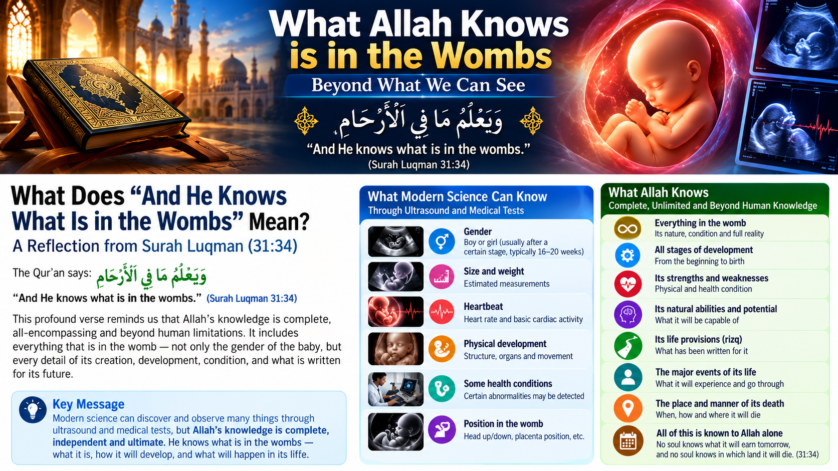
What Does “Allah Knows What Is in the Wombs” Really Mean?
Understanding Surah Luqman 31:34 in the Age of Ultrasound and Modern Science
A question frequently raised in discussions about the Qur’an and modern science concerns a statement in Surah Luqman, verse 34:
وَيَعْلَمُ مَا فِي الْأَرْحَامِ
“And He knows what is in the wombs.”
— Qur’an 31:34
The objection is usually presented like this:
“The Qur’an says Allah knows what is inside the womb. Today an ultrasound can tell us whether a baby is a boy or a girl. If humans can obtain this information, how can this be knowledge belonging to Allah?”
At first glance, this may sound like a conflict between scripture and science. But the problem arises when the Qur’anic statement is reduced to something the verse itself does not actually say.
The Qur’an does not say:
“Only Allah can ever know whether the fetus is male or female.”
It says:
“He knows what is in the wombs.”
That difference is fundamental.
What does the complete verse say?
Surah Luqman 31:34 states:
إِنَّ اللَّهَ عِندَهُ عِلْمُ السَّاعَةِ وَيُنَزِّلُ الْغَيْثَ وَيَعْلَمُ مَا فِي الْأَرْحَامِ ۖ وَمَا تَدْرِي نَفْسٌ مَّاذَا تَكْسِبُ غَدًا ۖ وَمَا تَدْرِي نَفْسٌ بِأَيِّ أَرْضٍ تَمُوتُ ۚ إِنَّ اللَّهَ عَلِيمٌ خَبِيرٌ
In meaning:
“Indeed, Allah alone has the knowledge of the Hour. He sends down the rain and knows what is in the wombs. No soul knows what it will earn tomorrow, and no soul knows in what land it will die. Surely Allah is All-Knowing, All-Aware.”
The context immediately shows that the verse is discussing something much greater than identifying fetal sex.
It speaks about Allah’s comprehensive knowledge and the limitations of human knowledge concerning realities that are hidden from us—particularly the future.
Does “what is in the wombs” simply mean gender?
No. The Arabic expression is:
مَا فِي الْأَرْحَامِ — mā fī al-arḥām
Literally: “what is in the wombs.”
The verse itself does not replace the word “what” with “male or female.”
Gender is certainly one fact concerning a fetus, but it is only one piece of information among countless others.
Allah knows whether the child is male or female, but His knowledge is not exhausted by that fact.
He knows the developing human being completely.
He knows its formation, physical condition and every stage through which it will pass. And within the broader Islamic understanding of Allah’s omniscience, He already knows the person’s entire life: the circumstances into which the person will be born, the provision (rizq) they will receive, the opportunities and trials they will encounter, the decisions they will make, how long they will live, and where their life will ultimately end.
That is fundamentally different from seeing fetal anatomy on a screen.
What can an ultrasound actually tell us?
Modern medicine is an extraordinary human achievement.
Ultrasound and other diagnostic technologies can provide doctors with considerable information about a developing fetus. Depending on the stage of pregnancy and the examination involved, doctors may observe:
- fetal sex;
- heartbeat;
- approximate size and weight;
- position in the womb;
- physical development;
- placenta and surrounding structures;
- and indications of certain medical conditions.
There is no need for Muslims to deny any of this.
In fact, even if medical technology eventually became virtually perfect at determining fetal sex, it would not contradict the wording of Qur’an 31:34.
Why?
Because the Qur’an never says:
“Human beings will never develop technology capable of identifying fetal sex.”
That is not the claim being made.
Science is obtaining specific information about an observable physical condition.
The Qur’anic statement concerns Allah’s knowledge in an entirely different and much more comprehensive sense.
Observation is not omniscience
Imagine that a doctor performs an ultrasound and correctly says:
“The fetus is female.”
The doctor has discovered something real.
But consider what the doctor still cannot read from that ultrasound image.
Will this girl live for twenty years or ninety?
Will she become a doctor, engineer, teacher or something nobody presently expects?
Will she become wealthy or poor?
What opportunities will enter her life?
What difficulties will she face?
Which decisions will she freely make?
What will she earn tomorrow, twenty years from now, or fifty years from now?
Where will she eventually die?
None of those answers appear on an ultrasound screen.
The difference, therefore, is not:
Allah knows the gender while humans know nothing.
The real distinction is:
Human beings can discover limited information through observation and instruments, whereas Allah’s knowledge is complete and independent.
Human knowledge is acquired; Allah’s knowledge is not
A doctor requires causes and instruments.
There must be a fetus at an observable stage. There must be equipment. The machine must produce data. A trained person must interpret that information.
The process looks something like this:
Physical reality → instrument → data/image → observation → interpretation → human knowledge
Human beings learn.
We move from not knowing something to knowing it.
Islamic theology describes Allah’s knowledge differently.
Allah does not need an ultrasound machine to discover the child’s sex.
He does not wait for organs to develop.
He does not perform experiments.
He does not calculate probabilities.
He does not acquire new information.
His knowledge is not dependent upon instruments, observations or the passage of time.
This is why comparing an ultrasound result with divine omniscience compares two very different categories of knowledge.
The rest of the verse explains the principle
Perhaps the clearest way to understand the womb statement is to continue reading the same verse:
“No soul knows what it will earn tomorrow.”
Does this mean that human beings cannot make plans for tomorrow?
Obviously not.
A person might say:
“Tomorrow I will go to work and earn my salary.”
That is a perfectly reasonable statement based upon present circumstances.
But does that person possess absolute knowledge of tomorrow?
No.
Something unexpected could happen. The workplace could close. The person could become sick. Another opportunity could arise. An emergency could completely change the day.
Most fundamentally, the person cannot guarantee that he will even be alive tomorrow.
Planning and prediction are therefore not identical to certain and comprehensive foreknowledge.
The verse then says:
“No soul knows in what land it will die.”
A person may plan to spend the rest of his life in Kuwait, Pakistan, Britain or America.
But planning where one expects to live is not the same thing as possessing certain knowledge of where one’s death will occur.
The same principle applies to the womb.
What about weather forecasting?
The verse also mentions rain:
“And He sends down the rain.”
Today we have satellites, radar, weather stations and sophisticated computer models.
Meteorologists can sometimes forecast rainfall with impressive accuracy.
Does that mean human beings have acquired divine knowledge?
No.
Meteorology observes atmospheric conditions that already exist and calculates probable future developments from them.
A weather forecast is based on measurements, models and physical causes.
Again, there is an enormous difference between:
detecting signs and predicting an outcome
and
possessing complete knowledge of reality independent of those signs.
The development of better weather forecasting therefore does not make humans omniscient any more than ultrasound does.
Science discovers what was previously hidden from us
There is another important point.
When scientists discover something, it does not mean that the reality came into existence when humans discovered it.
Gravity operated before Newton described it.
DNA existed before humans understood its structure.
Stars existed before telescopes.
Sound waves existed before ultrasound machines.
Human beings investigate creation and progressively discover how it works.
From the Islamic perspective, therefore, scientific discovery does not compete with Allah’s knowledge.
Discovering something that was previously unknown to us is not the same as making it previously unknown to Allah.
That distinction is crucial.
Does Allah also know the child’s future?
According to Islamic belief, yes.
Allah’s knowledge is not restricted to what the fetus currently is.
Allah knows what that person will eventually become and everything that will happen throughout that person’s existence.
This includes matters that an ultrasound could never answer:
Will this person believe or disbelieve?
What profession will he or she choose?
What good and bad decisions will the person make?
What provision will reach them?
What will they earn?
How long will they live?
Where will they die?
However, an important distinction must be maintained: not every one of these details is explicitly listed in the phrase “what is in the wombs.” Rather, they follow from the broader Qur’anic teaching that Allah possesses complete knowledge of creation, while 31:34 itself explicitly connects the womb, tomorrow’s acquisition and the place of death.
That makes the argument stronger because we do not need to put words into the verse that are not actually there.
Does Allah knowing our future mean He forces us to do it?
This leads to another important question.
If Allah already knows that a child will grow up and make certain decisions, does that mean Allah’s knowledge forces the person to make those decisions?
No.
Knowledge and causation are not the same thing.
In Islamic theology, Allah knows what choices a person will make, but the human being still genuinely chooses and is therefore morally accountable.
Allah does not need to wait for tomorrow to discover our decision.
From our perspective, tomorrow has not happened.
Allah’s knowledge, however, is not limited in the way human knowledge is.
This subject deserves its own discussion because divine foreknowledge and human free will are distinct from the ultrasound objection.
The objection changes the Qur’an’s claim
We can now see the fundamental problem with the common argument.
The objection says:
“The Qur’an claims only Allah can know whether a fetus is male or female.”
Then:
“Ultrasound can determine fetal sex.”
Therefore:
“The Qur’an is wrong.”
But the first statement is not what Qur’an 31:34 actually says.
The Qur’an says:
“And He knows what is in the wombs.”
Once the actual wording is restored, the supposed contradiction disappears.
Knowing one observable characteristic of something is not equivalent to possessing complete knowledge of that thing.
If I know the color, model and speed of a car, that does not mean I know everything that will happen to that car for the remainder of its existence.
Likewise, identifying the sex, heartbeat or size of a fetus does not amount to knowing the complete reality and future of the human being developing inside the womb.
Science and the Qur’an are answering different levels of the question
Science can ask:
What can we observe?
What can we measure?
What biological process is occurring?
What can present evidence allow us to infer?
These are valuable questions, and Islam does not require us to reject their answers merely because they come from scientific investigation.
The theological question is deeper:
Who possesses complete knowledge of reality—including what remains hidden from us and what has not yet occurred from our perspective?
The Qur’anic answer is Allah.
So an ultrasound showing “boy” or “girl” is not a defeat for the verse.
It is an example of human beings using intelligence, observation and technology to discover one part of a reality that is vastly larger than the information appearing on the screen.
Conclusion
Surah Luqman 31:34 should not be reduced to the statement:
“Only Allah knows whether the baby is a boy or girl.”
Its wording is broader:
وَيَعْلَمُ مَا فِي الْأَرْحَامِ
“And He knows what is in the wombs.”
Modern medicine may reveal gender, heartbeat, growth, position and many other aspects of fetal development. Future technologies may reveal even more.
None of that makes human knowledge equal to divine knowledge.
Science observes. Humans investigate. Technology reveals. Doctors diagnose. People predict and plan.
But all of these forms of knowledge remain dependent upon information available to us.
In the Islamic understanding, Allah’s knowledge is not acquired, partial or dependent. It encompasses the reality of the child in the womb and everything beyond our observation—past, present and future.
So the real comparison is not:
Ultrasound vs. the Qur’an.
It is:
Limited acquired human knowledge vs. complete divine knowledge.
And once that distinction is understood, knowing that a fetus is a boy or a girl does not contradict the Qur’anic statement at all.